What do we owe our parents?
What does the fifth commandment require of us?
This article doesn’t directly address family situations that involve abuse, debilitating mental or physical illness, trauma or other severe cases. If that’s your situation, I’d recommend talking with a local pastor or counselor.
In a letter to Lori Gottlieb’s “Dear Therapist” column in The Atlantic, a woman who signed herself Anonymous wrote:
“I am 43 years old with a 3-year-old daughter, and we live a few thousand miles away from my family … my mother, now 72, is deteriorating both mentally and physically. … Her drinking has begun to take a toll on her health in myriad ways. Recently, while highly intoxicated, she fell down the stairs in her home.
“She has been asking me for years to move home, and I’ve always been very clear that I would not. … I feel this tremendous guilt for no longer taking care of my mother. I know she needs me. But when I had my daughter, I made a promise to her, and to myself, that she would never grow up in the chaos that I did. … But am I just sentencing her to a different type of damage? The damage of teaching her to walk away from family in their time of need, and of denying her a relationship with a grandma who, despite being deeply flawed, loves her?”
What would you advise Anonymous to do?
Most of us aren’t facing Anonymous’s choice. But many of us will face a smaller version of it this holiday season.
The State of Estrangement
Anonymous’s tension—the conflict between the duty to care for aging parents and the desire to protect your kids (and yourself) from hardship—is neither new nor unique. Parents have failed children since Adam, the father of humanity, failed us all.
What’s new is what Ohio State sociologist Rin Reczek calls the shift from “compulsory kinship” to “democratized kinship.” Compulsory kinship sounds like this: my dad isn’t pleasant to be around, but he’s my dad, so I’ll see him on Thanksgiving. Democratized kinship says my dad isn’t pleasant, and I’d prefer Thanksgiving to be pleasant, so I think we’re busy this year.
In extreme cases, some are going “no contact” with their parents, cutting off the relationship entirely. Cornell sociologist Karl Pillemer’s national survey found that 27% of American adults—at least 67 million people—have cut off contact with a family member, and 10% are estranged from a parent or child.
As you might expect, there are influencers influencing all of this. In one recent month, more than 138,000 new TikTok videos mentioned estrangement or going “low contact” with parents, more than 10 times the count from August 2020, according to the analytics firm Infegy.
You might not be on TikTok. I’m not either. But we both inhabit a culture deeply confused by the question one adult child put to an advice columnist:
“What do I owe to parents who did their best, but whose best has hurt me?”
Weight
For Christians, the most direct instruction about how adults should honor their parents is the fifth commandment: “Honor your father and your mother” (Exod. 20:12). You may have heard those words from your mom or dad when you huffed and puffed about doing the dishes, but that’s not the primary application. As Jen Wilkin points out, all Ten Commandments, this one included, are given to adults, and they address adult sins.
So what does it mean?
The Hebrew word translated “honor” (kabed) comes from a root meaning heavy or weighty, the same root behind kavod, the word often translated “glory.” To kabed your parents means, literally, to give weight to them—in time, money, presence and respect.
Practically, honoring parents involves using discretion in what we say and what we choose not to say, both to their face and when they’re not around. “Sometimes we honor our parents by demonstrating forgiveness in what we leave unsaid,” writes Jen Wilkin. Rather than relaying our frustrations, Wilkin suggests telling our parents a favorite memory from childhood.
But words alone aren’t enough; practical and financial support is required. At the time of Moses, an older Israelite’s social security was their household. That’s why this command comes with a promise: “that it may go well with you in the land” (Deut. 5:16). If parents weren’t honored, it would not go well for anyone too old to work the land.
At this point, it’s helpful to remember Anonymous’s plight. Does the call to honor parents extend to those who have dishonored their children?
Consider Rabbi Tarfon, a Jewish teacher of the late first century.
The Talmud says he boasted that he kept this mitzvah (commandment) by serving as a physical footstool for his aging mother so she could get into bed. The sages replied that he hadn’t reached even half the honor she was due. The real test, they said, is a parent who behaves badly.
The Law of Christ
The Westminster Larger Catechism says the fifth commandment calls for “bearing with [a parent’s] infirmities, and covering them in love.”
That language echoes Paul’s instructions to the Galatians to “bear one another’s burdens, and so fulfill the law of Christ” (Gal. 6:2). Here law is used less in a legal sense than in a habitual one. It’s not merely that Christ’s law is to love our neighbor (and enemy); it’s that His automatic response to burdensome people is love.
That’s His law.
The law of Christ might better be called the Law of Loving Difficult People. Jesus, after all, has never loved anyone who was easy to love—you and me included. And His Law of Loving Difficult People is not a trivial love, a be-nice-to-you-from-a-distance-and-keep-Thanksgiving-pleasant sort of thing. It is kabed love, a suffer-and-bleed-and-die-for-you kind of love. It’s heavy with self-sacrifice.
If that is Christ’s law, is it ours?
“Behold, Your Mother!”
Jesus demonstrates kabed love with His own family.
If you think your family situation is rough, recall that midway through His ministry, Jesus’s family said He was “out of his mind” (Mark 3:21). They rejected His identity, full stop, and didn’t believe He was the Messiah. In a family-first traditional culture, this would have been excruciatingly painful. But Jesus pressed on, unwilling to accept His family’s attempt to shackle His identity and define Him. In this way, He reminds us that family allegiance is not ultimate; it’s always secondary.
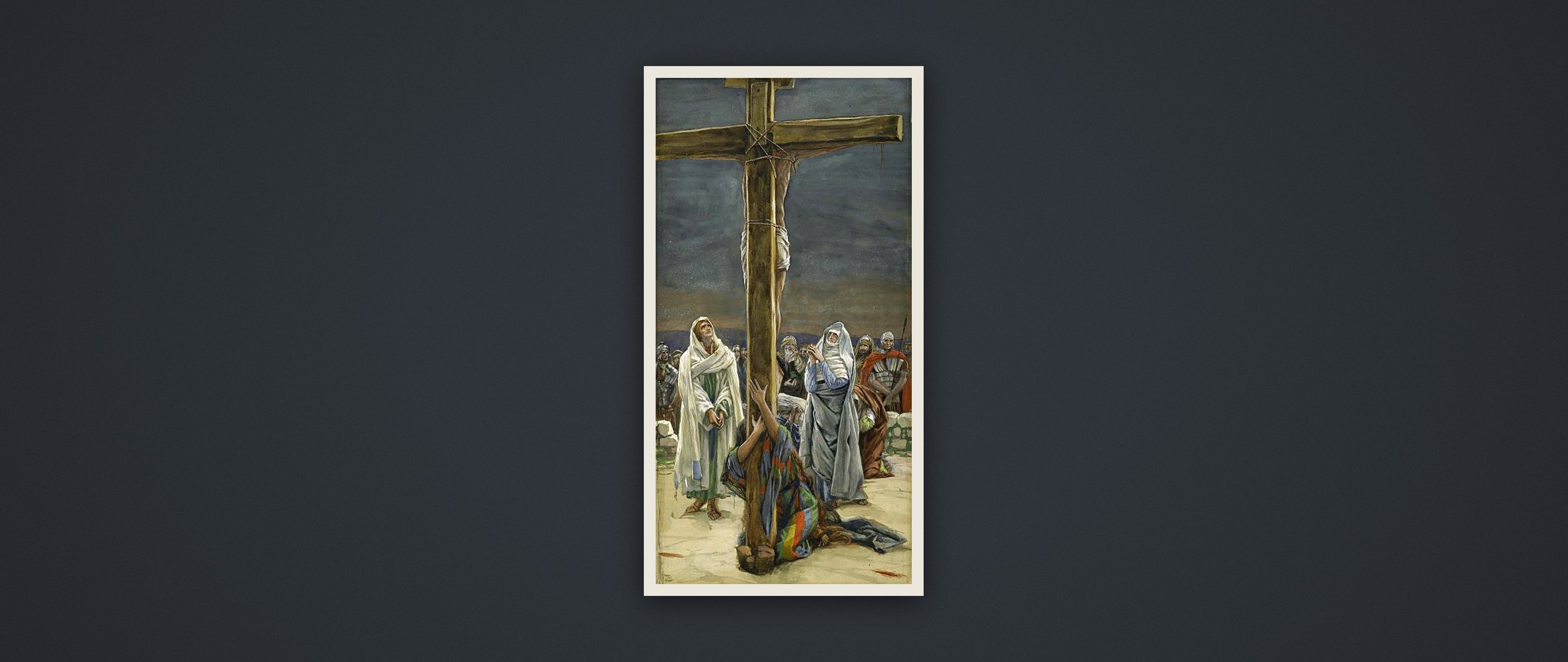
But right when we might think Jesus would let us go no contact with parents who dishonorable parents, He does the opposite. Moments before He dies, He sees His mother and His friend John standing nearby, and He says:
“Woman, behold, your son!” Then he said to the disciple, “Behold, your mother!” And from that hour the disciple took her to his own home. (John 19:26–27)
Rabbi Tarfon was a footstool for a good mom to help her sleep. Jesus Christ was the Lamb of God who died for a disbelieving family, and He still kept the commandment to kabed them even to His death.
In the defining moment of His life, the Son of God made sure His mother was cared for. That says something.
So what about Anonymous, and what about your very difficult relatives?
There is no easy answer, no directive for how to maintain boundaries and love at the same time. But there is the command to take the relationship weightily, and there is the example of Jesus Christ—whose family deserved far worse than most of our parents ever deserved, and who gave them far more than they could have imagined.
Knowing that, the question shifts from what do my parents deserve from me given what they've done to what must I do for them given what Jesus has done? Only you can answer that. I hope you'll answer it well this holiday season.

Lakelight Monthly
Curated resources, delivered on the last Saturday of the month.
By subscribing you agree to with our Privacy Policy and provide consent to receive updates from our company.