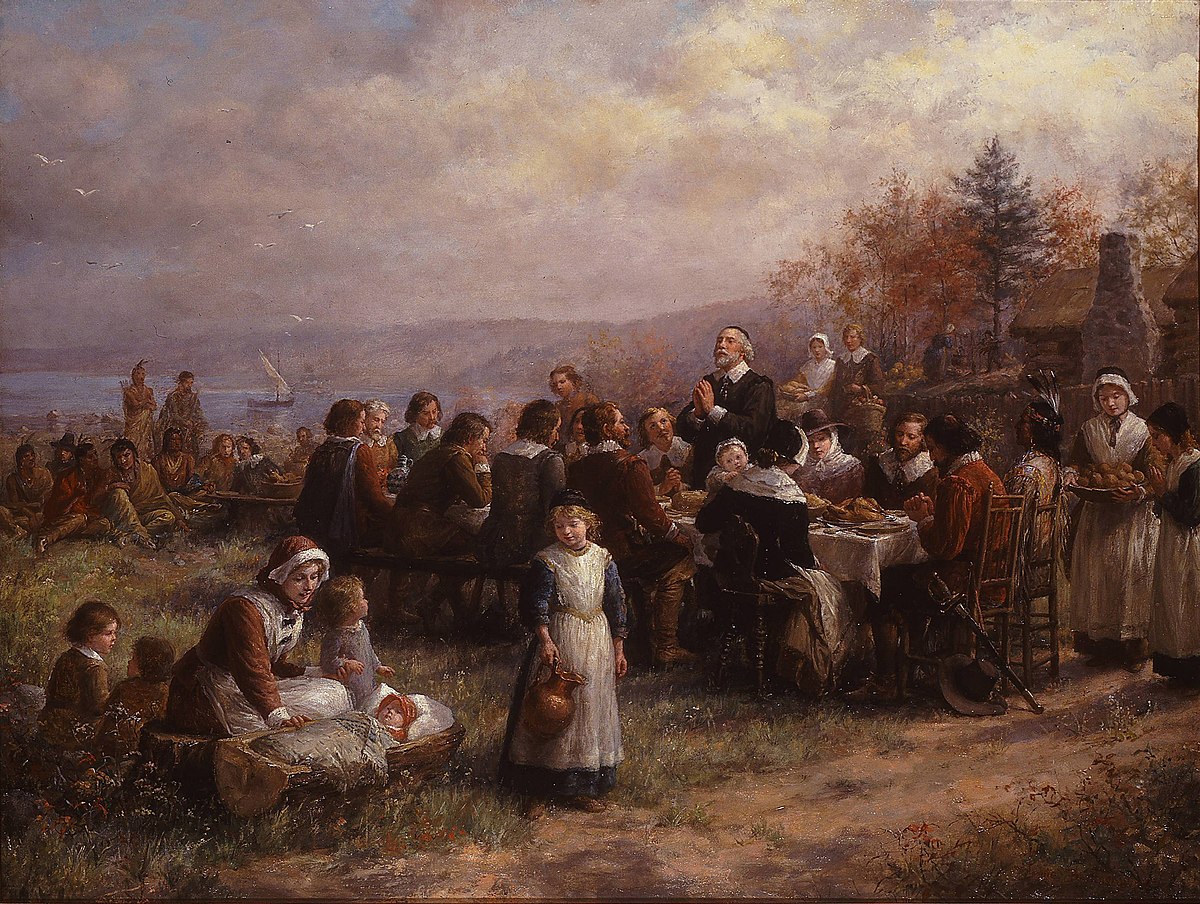
Thanksgiving and the Sensus Divinitatis
"The worst moment for an atheist is when he is really thankful and has no one to thank." — G.K. Chesterton
No One to Thank
In November 2009, at an Intelligence Squared debate at Wellington College, England, Richard Dawkins, the world’s most famous atheist, was giving his usual presentation on the ridiculousness of belief in God when he made the following comments about what he feels when he observes the beauty of the cosmos:
“When I lie on my back and look up at the Milky Way on a clear night and see the vast distances of space and reflect that these are also vast differences of time as well, when I look at the Grand Canyon and see the strata going down, down, down, down through periods of time which the human mind can’t comprehend...it’s a feeling of sort of abstract gratitude that I am alive to appreciate these wonders. When I look down a microscope, it’s the same feeling. I am grateful to be alive to appreciate these wonders.”
Wait a second. Something doesn’t add up. If there is no God, then to whom is Dawkins grateful for the wonders of the universe? Doesn’t his gratitude presume the existence of a divine gift-giver, the one to whom he is grateful?
Ethicist Alma Acevedo believes so. Writing for First Things, she states, “Gratitude is not a self-enclosed or self-sufficient feeling but a human person’s response to another person or persons, whether human or divine...As Kant succinctly observes, ‘The duty of gratitude consists in honoring a person because of a benefit he has rendered to us.’” And as Acevedo would later argue, for benefits like the Milky Way and the Grand Canyon, the only person to whom we could owe a duty of gratitude is God.
So, there appears to be an inconsistency between Dawkins’s atheistic head and the gratitude in his heart. His atheistic head tells him that, “The universe has precisely the properties we should expect if there is, at bottom, no design, no purpose, no evil, no good, nothing but blind, pitiless indifference.” But the gratitude in his heart tells him that his life and the beauty of nature are gifts that he should be thankful for, gifts which, as Acevedo argues, should point him towards God.
The Sensus Divinitatis
What does this conflict within Dawkins reveal?
That in the heart of even the most ardent atheist, there remains a remnant of what John Calvin called the sensus divinitatis (“sense of divinity”), an innate, God-given capacity to perceive God’s existence, particularly by observing the wonders of creation.
The biblical warrant for this concept is Romans 1:19-20, which says, “...what may be known about God is plain to them, because God has made it plain to them. For since the creation of the world, God’s invisible qualities–his eternal power and divine nature–have been clearly seen, being understood from what has been made, so that people are without excuse.” In his commentary on the passage, Calvin writes that God created humanity “to be a spectator of this formed world” so that “by looking on so beautiful a picture, [we might] be led up to the Author Himself.”
If that is so, then how is there atheism? Well, sin has marred the sensus divinitatis so that, apart from regeneration by the Holy Spirit, it provides knowledge of God that is, as philosopher Alvin Plantinga puts it, “both narrowed in scope and partially suppressed.” However, sin has not stifled it entirely, a fact that can be seen by the prevalence of theistic/polytheistic belief in history. The Roman orator and philosopher Cicero observed that “There is no nation so barbarous, no race so savage, as not to be imbued with the conviction that there is a God.”
What Cicero would’ve made of Dawkins’ atheism, who can say, but as argued for earlier, Dawkins’ gratitude for life and the beauty of nature suggests that the sensus divinitatis is, indeed, within him, pointing him to the God to whom he should be grateful.
Atheist Rejoinders
But can’t atheists respond by saying that they are grateful to the impersonal universe for the blessings of life? Not really. As Islamic scholar Shabir Ally explains, “When we speak of gratitude, we often think of someone deliberately or intentionally giving us the thing for which we are grateful. If somebody has so much money [that]...$100 bills are falling out of his pockets as he walks, and we pick up those $100 bills, we don’t rush after him to thank him...because he didn’t intend to give it to us.”
Ally’s point is that gratitude assumes intentionality on the part of the giver. And just as we would not thank a man for accidentally dropping $100 bills that we then pick up, we wouldn’t thank an impersonal universe for accidentally producing all the good things of life. Our gratitude for these things only makes sense if we assume a personal giver.
Dawkins, however, wouldn’t take this line of atheist response. Instead, he would seek to undercut the validity of his gratitude feelings by appealing to evolutionary psychology. According to evolutionary psychology, our feelings of gratitude originally evolved to promote social cohesion. By expressing thankfulness to one another, tribe members were better able to work together, thus increasing their chances of survival. Unfortunately, this instinct for gratitude can sometimes misfire, producing gratitude when there is, in fact, no one to be grateful to. So, far from pointing to a divine giver, thankfulness for, say, the existence and beauty of the universe points merely to an overzealous gratitude instinct.
One of the best counters to this line of reasoning comes, unsurprisingly, from C.S. Lewis. In his famous argument from desire, Lewis notes that a basic pattern of nature is that our innate, natural desires correspond to something real. Hunger corresponds to food, thirst to water, sexual desire to sex, tiredness to sleep, and curiosity to knowledge. Although not listed by Lewis, I’d argue that giving thanks for the blessings of life is also an innate/natural desire. We can see this by the fact that it is a fundamental aspect of nearly every world religion, and by the fact that it naturally emerges in someone as secular as Richard Dawkins. Therefore, it points us to something real, the one who gives the gifts, namely God.
Not a Matter of Chance
There is an undeniable givenness to things, a givenness that rebels against the idea that life’s greatest gifts are the result of impersonal chance. Take love, for example. How plausible is it that a mindless, purposeless universe could accidentally produce something as powerful and meaningful as love? Yet, under the atheist view, love is nothing more than an evolutionary accident.
It was this realization about love that caused Jennifer Fulwiler to turn from atheism. In her testimony, she says that she never doubted her atheism until she had her first child. She recalls, “After my first child was born, I looked down and thought to myself, ‘What is this baby?’ And I thought, ‘Well, from a pure atheist materialist perspective, he is a collection of randomly evolved chemical reactions.’ And I realized that if that’s true, then all the love that I feel for him is nothing more than chemical reactions in my brain. And I looked down at him, and I realized that’s not true, that’s not the truth.” This rejection of the atheist materialist view of love put her on a path that eventually led to her becoming a Christian.
Perhaps there is a loved one in your life who is a Dawkins-esque atheist, who seems so far from belief in the Lord. But remember, because of the sensus divintatis, atheists are not as atheistic as they think. We see this when they passionately defend concepts or engage in practices that only really make sense on a theistic worldview. They may say humans are just another randomly evolved animal, yet champion human rights. They may say ethics is relative, yet appeal to objective morality. And they may say, like Dawkins, that “pitiless indifference” created the universe, yet feel overwhelming gratitude when gazing upon its wonders. And as we saw in Fulwiler’s testimony, becoming aware of these incongruencies can be used by the Holy Spirit to bring them to faith.
So, this Thanksgiving season, let us pray that when our atheist friends and family members reflect on the blessings of life, the Holy Spirit will prompt them to ask, “To Whom am I thankful?”

Lakelight Monthly
Curated resources, delivered on the last Saturday of the month.
By subscribing you agree to with our Privacy Policy and provide consent to receive updates from our company.