“Christopher Nolan played a trick on us...This “Odyssey” ostensibly hinges on Zeus’ law: Treat the beggar and the stranger as you would want to be treated. But as a horde of classicists have pointed out, that is not the law of Zeus…Nolan has smuggled the core of Judeo-Christian ethics into “The Odyssey.” Zeus’ law, in Nolan’s “Odyssey,” echoes Leviticus 19:34: “The foreigner residing among you must be treated as your native-born. Love them as yourself, for you were foreigners in Egypt…It echoes Matthew 7:12, when Jesus says, “In everything, do to others what you would have them do to you, for this sums up the law and the prophets.” (adapted from Ezra Klein’s review of The Odyssey)
Ezra Klein is correct. Zeus called for kindness to foreigners and beggars, not because they are equal to you, but because they could be a god in disguise and you don’t want to receive their wrath.
The Parable of the Good Samaritan outlines Jesus' take on the matter. He commands compassion to the weak because they are weak; Zeus commands hospitality to the weak because they could secretly be strong.
But Christopher Nolan isn't the only one smuggling in Judeo-Christian ethics these days. The entire western moral tradition stands on a religious foundation. The book that broke the news to everybody—Not-Spiderman-Tom-Holland’s book Dominion—is now almost 10 years old.
Klein’s column about “The Odyssey” is one example of what this article will call The Ache —the longing for God to fill a gap in our secular culture. Nolan doesn’t believe in a traditional God, but he believes that everyone is worthy of honor and respect, and yet a universe of natural forces doesn’t lead you to believe that. The friction between the universe he wants to believe in (one that grounds human equality) and the universe he claims to believe in (one that runs red in tooth and claw) causes an Ache.
The Apocalypse of Artificial Intelligence
(The following hyperlinks take you to quotations of actual interviews where AI executives/believers/researchers/developers have said what the sentence claims.)
First, the obvious: AI believers claim that their technology will provide what we once thought only God could give. Immortality, for example. Brian Johnson, the billionaire whose quest to defeat death earned him a Netflix documentary, believes that recursive self-improving AI models will revolutionize personal health care and expand our life expectancy to at least 150, possibly forevermore. Johnson has counted the cost of his faith—he’s sacrificing millions of dollars every year and thousands of days spent waking up at the same time and conducting experiments on his own body in his quest to defeat death. He’s called himself the first don’t die homo sapien prototype; I’ll call him the firstborn of AI’s creation.
If his fellow AI fans are correct, our eternal life will be life to the full—a utopia of “radical abundance” to be enjoyed by people who work one day a week, brought to you by Universal High Income. “The Machines can make all the food and the stuff, and we don't have to work as hard,” according to Bill Gates. Having everything we could ever want, we will also know everything that can be known or perhaps we’ll settle for just knowing “all of physics.” Once we knew in part, but now….
Other AI developers are less sanguine about where things are headed. I take great comfort though, that Anthropic employee Drake Thomas believes human extinction is only "40% likely.”
If those extreme outcomes are potentially escapable, widespread economic disruption is certain. The singularity—the day of the Machine Lord—will come soon. Will be we found upskilling while the master is gone, or will we be found sitting around on our analog laurels? Will it even matter?
Jasmine Sun, a journalist who covers AI and Silicon Valley Culture, can think of multiple instances where she’s asked AI developers behind closed doors how exactly their technology will achieve all of this, and they respond “Oh, I don’t know. It’s just going to do it.” Amazing faith—blessed are those who believe even when they don’t see.
Our collective hope vested in AI reveals humanity's drive to defeat death and to believe that a New Dawn will redeem our current pains. If we're honest, we're more like Brian Johnson than we'd like to admit. We want an everyday life that is aligned with a cosmic and apocalyptic hope.
Many numb that desire by endless time spent in front of a screen or by cosplaying politics on social media. Yet others—like Brian Johnson—won’t go quiet into the night of meaninglessness. They will rage and plot and conspire against humanity’s limits—and I suspect He who sits in Heaven is having a little chuckle. (Psalm 2:1-4)
“Everything Can Have Purpose If You Let It”
“Nobody Wants This,” the chart-topping Netflix television series, revolves around the romance between a congenial rabbi named Noah (played by Adam Brody) and a gentile, blonde, and very-millennial podcaster named Joanna (played by Kristen Bell). In episode one of the first season, they meet at a party and the sparks get off the ground, but they’re likely to never meet again, being in separate social circles.
Later in the same episode, Noah is asked to give a teaching to his synagogue during the Shabbat Service. He tells the parable of the man stranded on a raft, who cried out to God for deliverance but still died. The man then asks God in Heaven “why didn’t you help me?” God responds “I sent you a raft and a helicopter.”
(you can watch the rest of the scene here.)
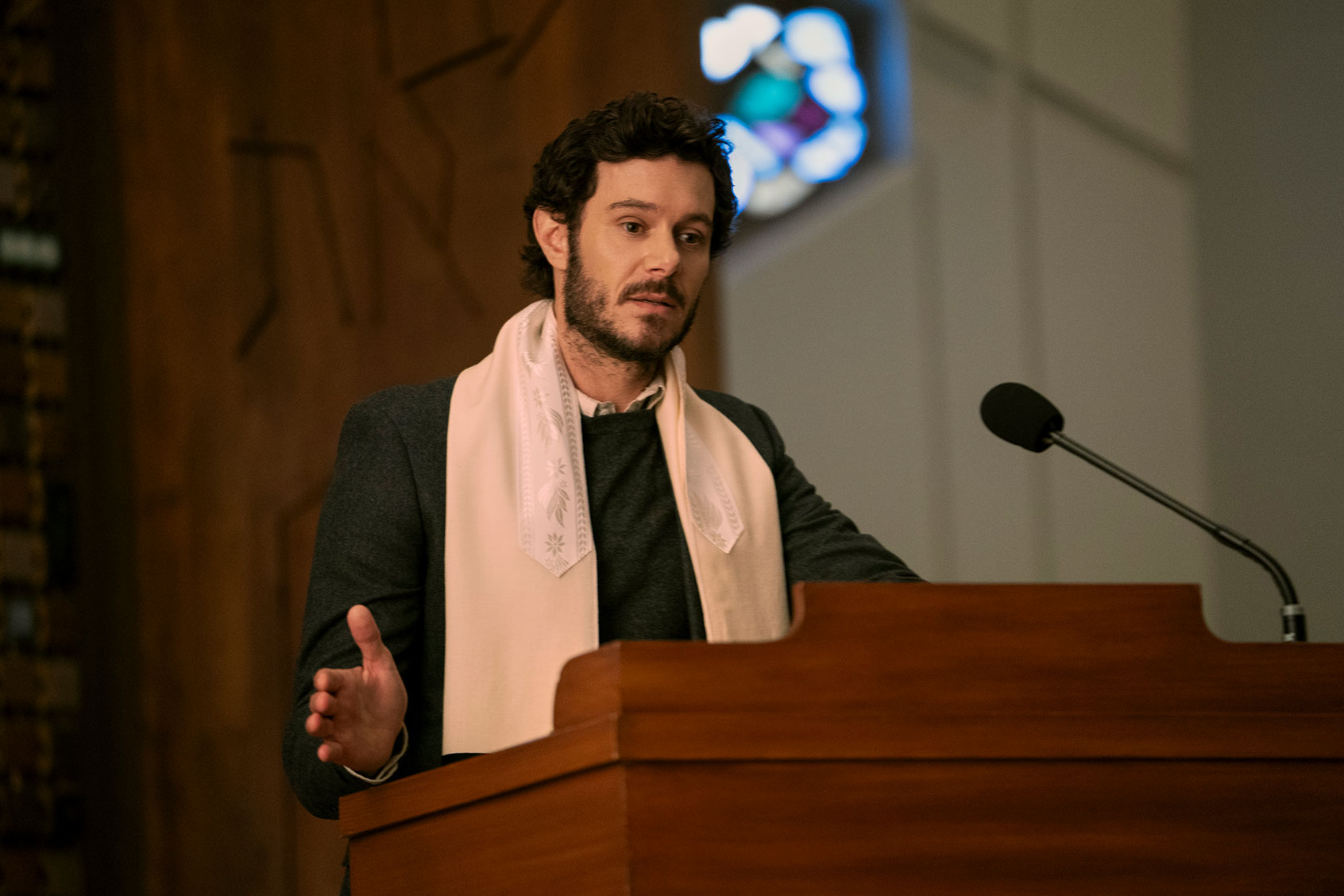
As he’s saying this parable, Joanna rushes into the synagogue and their eyes meet.
Noah pauses. He sees her, takes a breath and continues his teaching with her in mind:
“We have all these chances to wake up and change the course of our lives. Everything can have purpose if you allow it. Thinking about switching careers. Maybe that’s God pushing you. Hesitating about a big decision? That could be God telling you to think twice…But if you think God’s plan is supposed to feel like something specific, and you haven’t felt it and you wonder if we’re all, in on some big secret that you aren’t in on, let me tell you, you’re in on it. Shabbat Shalom.”
It’s a soaring moment and Joanna is visibly moved. She’s as secular as it gets, but she’s willing to take a chance on Noah because she senses God is nudging her toward him. The story goes on (I won’t spoil anything).
This scene captures the promise and the pitfall of religion in a secular world. Religious or not, we want to believe our lives are on an Intended track, that we’re fulfilling our purpose. In a strange paradox, we want both to be the authors of our stories—to have agency—and yet we want unexpected blessings, unpredictable turns, a life that happens to us even as we steer its course. We want to “fall in love," to be guided by Someone into the life we yearn for. We want God.
But we also want to preserve our own autonomy. Noah says that “Everything can have purpose if you allow it.” We want to look back on our day and say that everything happened for a reason, but we don't want to submit to an Authority who's the King whether you allow it or not. We want God, but we want Him on our own terms.
------------------------------------------------------------------------------------------------------------------------------------------------------------------------
“I don’t believe in God, but I miss Him.” — Julian Barnes
We want a view of the universe that supports our deepest moral values, we want a defiant hope that the future will make all things well, and we want a confidence that our choices are aligned with the stars. We want God. But we don’t believe in Him anymore.

Lakelight Monthly
Curated resources, delivered on the last Saturday of the month.
By subscribing you agree to with our Privacy Policy and provide consent to receive updates from our company.